
Presque personne n’est renouvelé par surprise parce qu’il est négligent — les gens se font prendre parce que les renouvellements sont conçus pour être invisibles. L’e-mail de confirmation arrive une fois, des mois avant le prélèvement. Le rappel (s’il y en a un) arrive le jour du renouvellement, quand il est trop tard pour annuler. Et le prix grimpe discrètement de 15 % au moment exact où vous avez oublié que le service existe. La solution n’est ni la volonté ni un tableur que vous abandonnerez d’ici février. C’est un système léger qui capture chaque date de renouvellement au moment où la confirmation atterrit dans votre boîte mail, vous avertit avec un vrai délai, et vous laisse décider exprès plutôt que par défaut. Ce guide vous accompagne pour construire ce système — et comment le faire tourner tout seul.
Pourquoi les renouvellements piègent même les gens organisés
Les renouvellements jouent contre vous dans le temps. Votre assurance auto confirme en mars et se renouvelle en septembre. Un essai gratuit s’inscrit le 3 et se convertit le 17. Un abonnement annuel que vous avez utilisé deux fois en janvier vous prélève à nouveau 51 semaines plus tard. Le signal (la confirmation) et le coût (le prélèvement) sont séparés par tant de temps qu’aucune mémoire de travail ne peut combler l’écart.
En plus de ça, la notification est conçue pour arriver trop tard. La plupart des e-mails « votre formule se renouvelle » arrivent un à trois jours avant le prélèvement — dans la fenêtre où annuler vous prélève quand même, ou où vous ne pouvez pas obtenir de remboursement. Et les hausses de prix ne sont presque jamais annoncées haut et fort ; le nouveau montant apparaît simplement sur le relevé.
Le but n’est donc pas d’« être plus assidu ». C’est de déplacer le point de décision plus tôt : capturer la date de renouvellement dès l’arrivée de la première confirmation, et recevoir un rappel des semaines à l’avance — pendant que vous avez encore le levier pour annuler, rétrograder, ou chercher un meilleur tarif.
- La confirmation arrive des mois avant le prélèvement — assez longtemps pour l’oublier
- Les rappels intégrés se déclenchent trop tard pour annuler sans payer
- Les hausses de prix sont silencieuses — le nouveau montant apparaît simplement sur votre carte
- Assurances, abonnements et formules se renouvellent chacun sur des cycles différents que vous ne pouvez pas garder en tête
Construisez une seule liste de chaque renouvellement — avec dates et montants
Vous ne pouvez pas gérer ce que vous ne voyez pas. Le premier geste est une seule liste de tout ce qui se renouvelle automatiquement : abonnements de streaming et d’applis, adhésions de salle de sport et de club-entrepôt, assurance voiture/habitation/locataire/animal, noms de domaine, stockage cloud, cotisations professionnelles, même ce coffret repas que vous avez mis en pause.
Pour chacun, capturez quatre choses : ce que c’est, combien ça coûte, à quelle fréquence ça se renouvelle, et la date exacte du prochain renouvellement. Ce dernier champ est celui qui fait le travail — c’est ce qui transforme une liste statique en système d’alerte précoce.
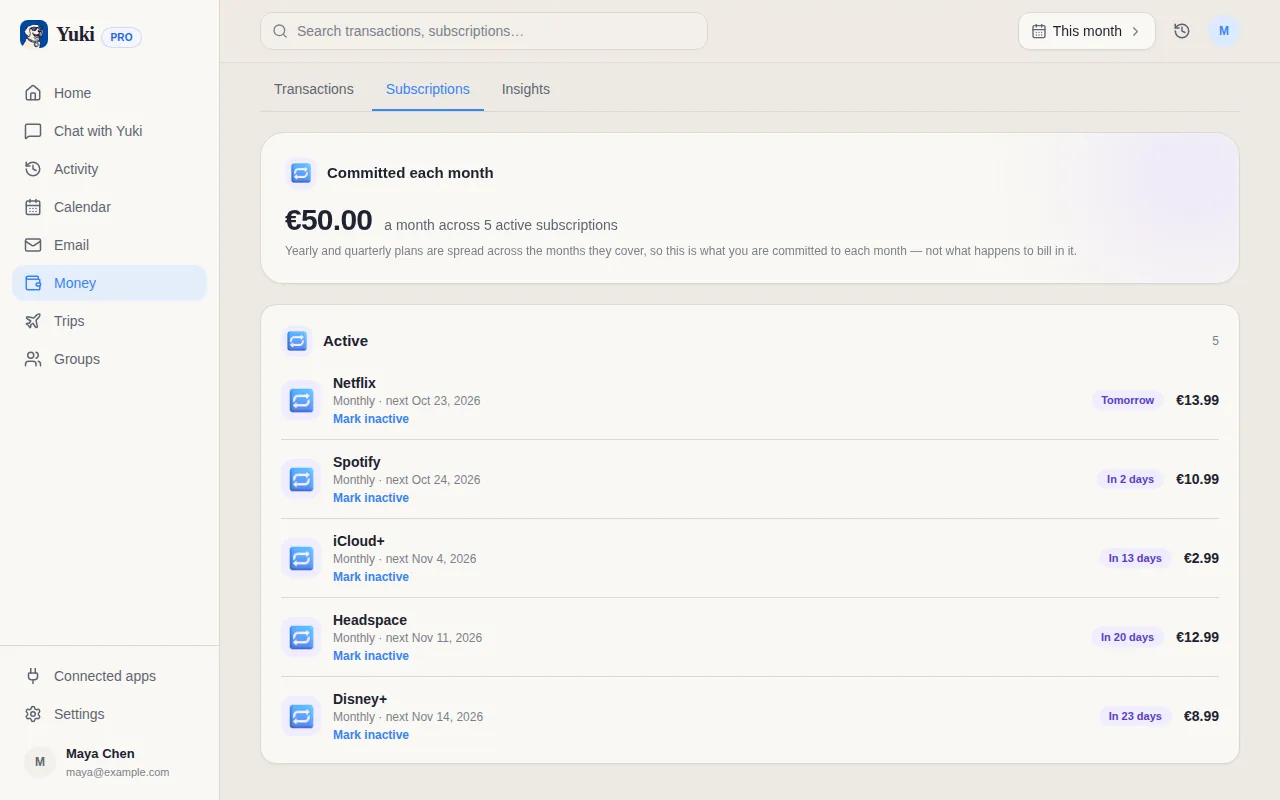
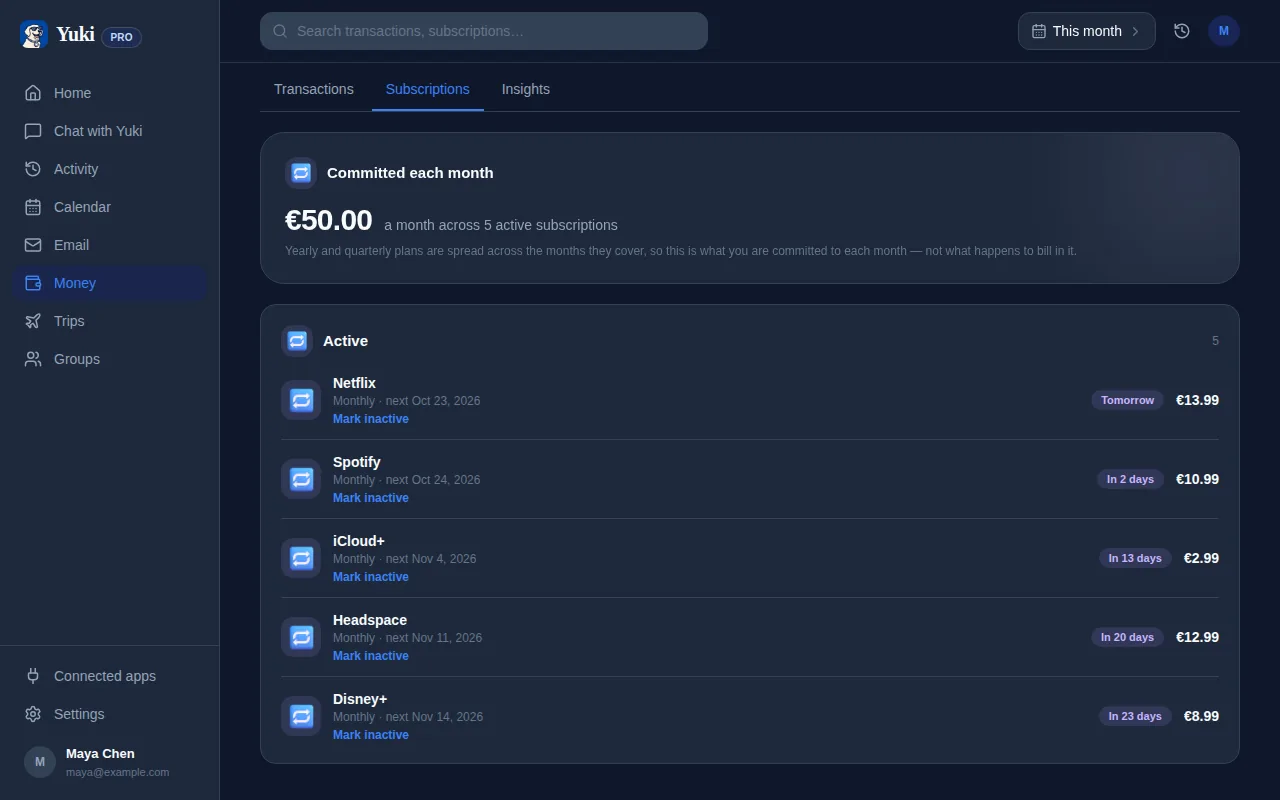
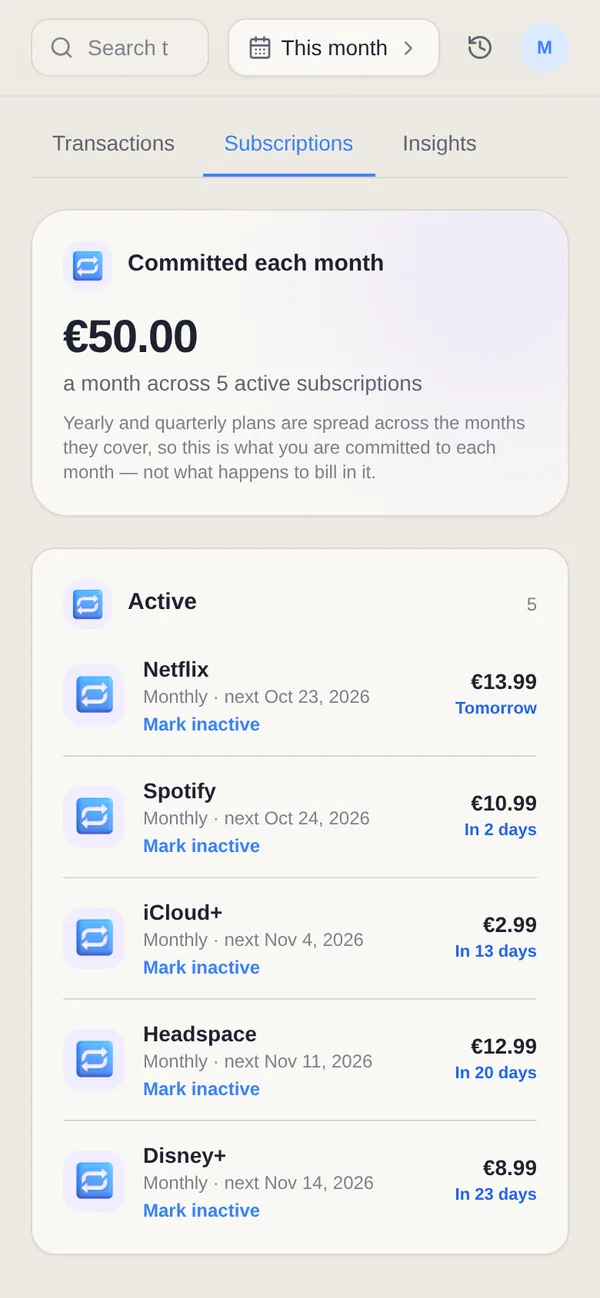
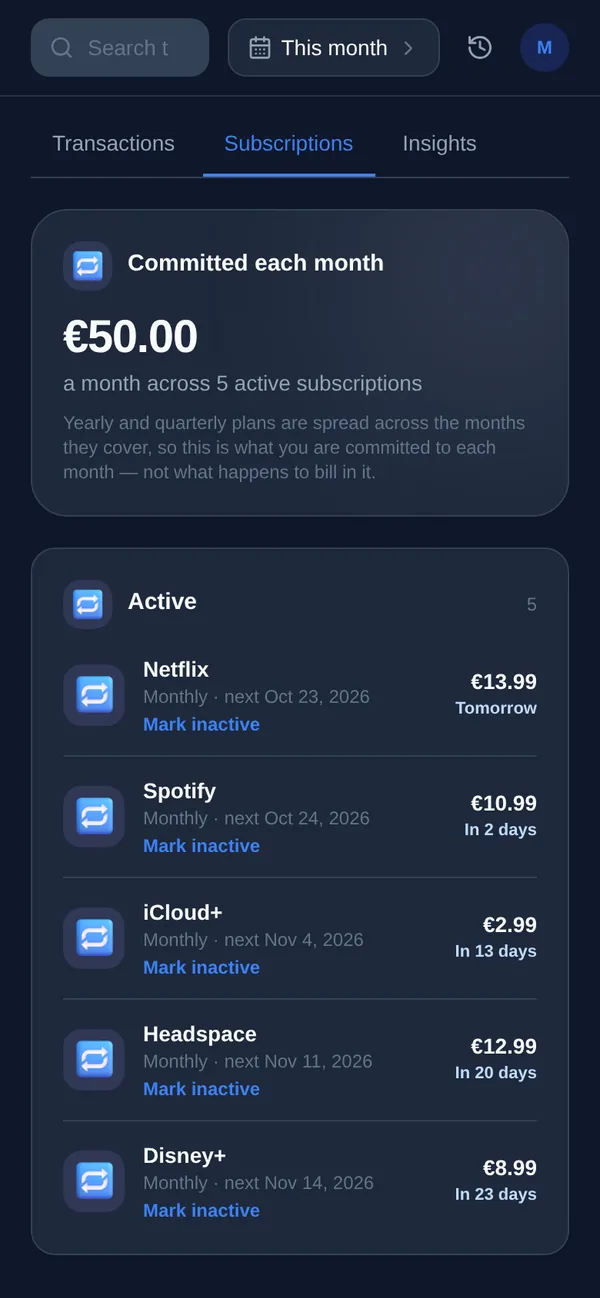
La méthode fastidieuse est de fouiller à la main dans les relevés de carte et les e-mails. La méthode la plus rapide est de laisser quelque chose lire votre boîte mail pour vous : les reçus, confirmations et e-mails « votre abonnement » sont déjà là. Yuki se connecte à Gmail et transforme ces messages en une liste à jour d’abonnements et de dépenses suivis automatiquement — donc la liste se construit toute seule et reste à jour à mesure que de nouveaux services sont ajoutés.
- Capturez le nom, le coût, la fréquence, et la prochaine date de renouvellement de chaque élément
- Incluez ceux qu’on oublie facilement : assurance, noms de domaine, cotisations annuelles, services en pause
- Tirez les données des e-mails de confirmation plutôt que de les taper de mémoire
- Laissez le suivi des abonnements de Yuki garder la liste à jour pour qu’elle ne devienne pas obsolète
Fixez des rappels avec un vrai délai — pas le jour même
Un rappel qui se déclenche le jour où une police se renouvelle n’est qu’une notification d’un prélèvement que vous ne pouvez plus arrêter. Fixez votre délai pour correspondre à la décision que vous voudriez prendre : 30 jours avant le renouvellement d’une assurance (assez de temps pour obtenir des devis concurrents), 3 à 7 jours avant la conversion d’un essai, et une semaine avant qu’un abonnement annuel ne se reprélève.
L’intérêt du délai, c’est le levier. Trente jours avant, vous pouvez vraiment appeler votre assureur, mentionner un devis plus bas, et souvent obtenir un alignement. Une semaine avant le renouvellement annuel d’une salle de sport, vous pouvez évaluer honnêtement si vous l’utiliserez — et annuler calmement au lieu de subir une année de plus.
Comme Yuki connaît déjà les dates de renouvellement grâce à votre boîte mail, il peut les mettre sur votre agenda et envoyer une notification intelligente à l’avance, pour que le rappel vous atteigne pendant que vous pouvez encore agir. C’est la différence entre « vous avez été prélevé » et « vous avez une semaine pour décider ».
Surveillez la hausse progressive de prix, et auditez sur un rythme
Les renouvellements les plus coûteux ne sont pas ceux que vous avez oubliés — ce sont ceux que vous avez gardés à un prix auquel vous n’avez jamais consenti. Les primes d’assurance et les niveaux d’abonnement dérivent vers le haut à chaque cycle. Quand vos renouvellements vivent à côté de leurs montants au même endroit, un saut de 12 € à 18 € est évident au lieu d’être invisible.
Offrez-vous un audit récurrent — trimestriel suffit amplement. Parcourez toute la liste et posez trois questions à chaque élément : ai-je utilisé ça, le prix a-t-il augmenté, et y a-t-il un équivalent moins cher ? C’est là que le « désencombrement numérique » annuel fait économiser de l’argent réel, et ça prend quinze minutes quand la liste est déjà construite.
Si vous partagez les finances avec un partenaire ou des colocataires, faites l’audit ensemble. Les groupes partagés de Yuki permettent aux couples, familles et colocataires de voir la même liste d’abonnements et de factures et de partager ou solder les coûts, pour que vous ne payiez pas tous les deux pour des forfaits de streaming qui se chevauchent ou que vous ne soyez pas sûr de qui couvre l’assurance.
Étape par étape
- 1Listez chaque prélèvement récurrent : abonnements, adhésions, et chaque police d’assurance — ou connectez votre boîte mail pour que la liste se construise toute seule depuis les e-mails de confirmation existants.
- 2Pour chaque élément, enregistrez le coût, la fréquence de renouvellement, et la date exacte du prochain renouvellement.
- 3Mettez chaque date de renouvellement sur votre agenda avec un rappel qui se déclenche avec un vrai délai — 30 jours avant pour l’assurance, quelques jours avant la conversion des essais gratuits.
- 4Quand un rappel arrive, décidez activement : garder, rétrograder, chercher un meilleur tarif, ou annuler avant le prélèvement.
- 5Chaque trimestre, auditez toute la liste à la recherche de hausses de prix, services inutilisés, et alternatives moins chères.
- 6Pour les coûts partagés, passez en revue avec votre partenaire ou colocataires pour que personne ne paie deux fois et que tout le monde sache qui possède quel renouvellement.