
La plupart des déséquilibres dans un foyer ne concernent pas qui fait la vaisselle — c’est qui se souvient qu’il faut la faire, remarque qu’il n’y a plus de savon, suit le rendez-vous chez le pédiatre, et garde la liste courante de tout ce qui doit se passer cette semaine. Ce travail de se souvenir et de coordonner, c’est la « charge mentale », et elle est généralement invisible, tue, et portée par une seule personne. Diviser les tâches 50/50 ne corrige rien si un partenaire reste le manager qui assigne les tâches. Le vrai but est de rendre la logistique de votre vie commune visible pour vous deux, pour que remarquer, planifier et se souvenir deviennent un système partagé plutôt que le deuxième travail d’une seule personne. Ce guide vous accompagne pour le faire concrètement.
Nommez d’abord le travail invisible
Avant de pouvoir diviser équitablement les responsabilités, vous devez toutes les voir — et la plupart des couples ne discutent que des visibles. Cuisiner, nettoyer et faire la lessive sont évoqués parce que c’est tangible. Mais les tâches qui causent vraiment le ressentiment sont celles que personne ne nomme : savoir que le chien doit être vacciné, remarquer qu’il faut acheter le cadeau avant la fête, suivre quand l’immatriculation de la voiture expire, se souvenir quelles soirées ont l’entraînement de foot.
Asseyez-vous ensemble et écrivez chacun tout ce que vous suivez personnellement. Soyez précis et incluez le travail de « remarquer », pas seulement de « faire ». Cet exercice est souvent la première fois qu’un partenaire réalise à quel point l’autre porte de charge cognitive. La liste elle-même est l’intervention — vous ne pouvez pas partager une charge que vous ne pouvez pas voir.
- Incluez les tâches ponctuelles-mais-récurrentes : renouvellements, rendez-vous, achats de cadeaux, réapprovisionnement.
- Séparez « qui le fait » de « qui se souvient qu’il faut le faire » — c’est souvent la même personne.
- Repérez les tâches de « manager » : déléguer, rappeler et suivre sont aussi du travail.
Divisez par domaine, pas par tâche
L’erreur la plus courante est de diviser les tâches individuelles pendant qu’un partenaire reste le manager qui les assigne. Si c’est vous qui dites « peux-tu réserver le dentiste » et « n’oublie pas la facture d’électricité », vous portez toujours la charge mentale même si votre partenaire fait la tâche physique. C’est de la délégation, pas du partage.
À la place, cédez des domaines entiers. Une personne possède les courses de bout en bout — remarquer ce qui manque, construire la liste, planifier les repas, faire les courses. L’autre possède les finances de bout en bout — suivre les factures, repérer les renouvellements, gérer le budget. Quand quelqu’un possède tout un domaine, il porte à la fois la réflexion et le faire, et l’autre personne peut vraiment lâcher prise. Faites tourner les domaines tous les quelques mois si vous voulez de la variété, mais évitez de diviser un seul domaine en deux.
- Assignez la pleine propriété d’un domaine, y compris le fait de remarquer et de planifier, pas seulement l’exécution.
- Visez à éliminer le rôle de « manager du foyer » plutôt qu’à le partager.
- Choisissez des domaines qui correspondent aux forces ou préférences de chacun quand c’est possible.
Sortez-la de vos têtes pour la mettre dans un seul endroit partagé
Une division équitable ne tient que si les deux partenaires peuvent voir l’image complète. Quand les engagements vivent dans la mémoire d’une seule personne, cette personne reste la source de vérité — et le point de défaillance unique. La solution est une source partagée que vous pouvez tous les deux consulter sans vous demander l’un à l’autre : un agenda partagé pour les rendez-vous et événements, une liste partagée pour les courses et commissions, et une vue partagée des factures et de qui paie quoi.
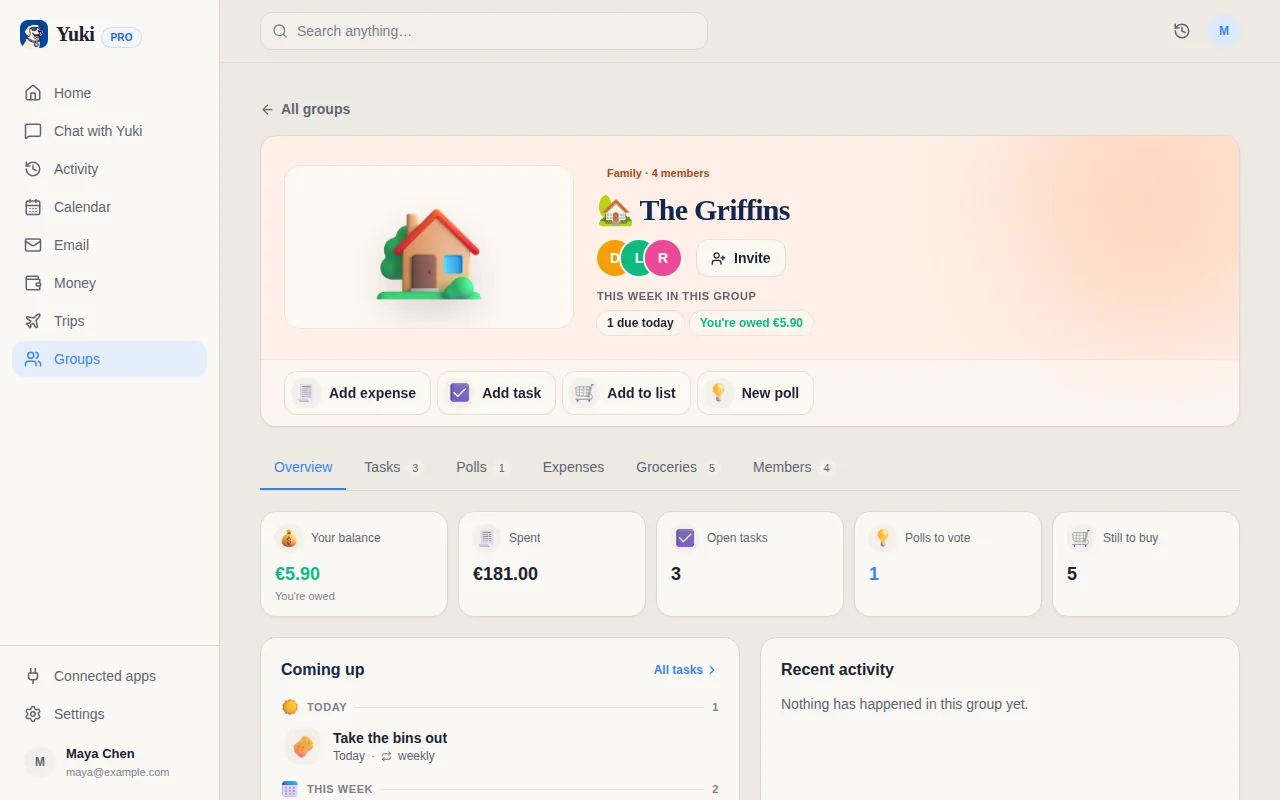
C’est là qu’un outil comme Yuki retire une grande partie de l’entretien manuel. Yuki se connecte à votre e-mail et transforme automatiquement les confirmations, reçus, factures et invitations déjà présents dans votre boîte mail en un agenda à jour, des dépenses et abonnements suivis, et des rappels — donc rendez-vous et échéances apparaissent sans que personne ne les tape. Ses groupes partagés sont conçus exactement pour les couples : un agenda partagé, des tâches et listes de courses partagées, et un partage de factures avec solde des comptes, tout au même endroit que les deux partenaires peuvent voir. Le but n’est pas l’appli pour elle-même — c’est qu’un système fasse le travail de mémoire, pour qu’aucun de vous deux n’ait à être la mémoire du foyer.
- Utilisez un seul agenda partagé pour que les rendez-vous ne soient pas piégés dans le téléphone ou la tête d’une seule personne.
- Gardez une liste de courses et de commissions partagée à laquelle n’importe qui peut ajouter sur le moment.
- Rendez visibles les factures et qui doit quoi pour que l’argent ne soit pas le fardeau silencieux d’une seule personne.
Automatisez le fait de se souvenir
La partie la plus lourde de la charge mentale n’est pas de faire les tâches — c’est de les garder en tête pour qu’elles ne passent pas à la trappe. Si une personne doit se souvenir, cette personne travaille encore même quand rien n’est fait. L’antidote, c’est de laisser un système faire ce travail de mémoire : rappels automatiques pour les factures avant leur échéance, alertes pour les renouvellements d’abonnement pour ne pas être surpris par un prélèvement, et notifications pour les anniversaires et rendez-vous.
Quand Yuki lit l’avis de renouvellement dans votre boîte mail et vous rappelle à tous les deux avant que l’abonnement annuel ne soit reprélevé, personne n’a eu à être responsable de le suivre. C’est le changement — vous remplacez « un partenaire se souvient de tout » par « le système fait ressortir ce qui compte pour nous deux ». Ça réduit le stress de fond de sentir que vous êtes le seul à tenir toute l’image ensemble.
- Fixez des rappels pour les factures et renouvellements récurrents pour que rien ne dépende de la mémoire.
- Laissez les anniversaires et rendez-vous déclencher des notifications automatiques aux deux partenaires.
- Visez un système où oublier est un défaut de conception, pas un échec personnel.
Gardez l’équilibre avec un court point hebdomadaire
Même la meilleure division dérive. Quelqu’un devient occupé, un domaine s’alourdit pour une saison, une nouvelle responsabilité apparaît. Un point hebdomadaire de 10 minutes empêche les petits déséquilibres de se transformer en ressentiment. Asseyez-vous, jetez un œil à l’agenda partagé pour la semaine à venir, signalez tout ce qui nécessite une coordination, et demandez-vous honnêtement si la charge semble toujours équitable.
Traitez-le comme de l’entretien, pas comme une confrontation. Le but n’est pas un registre 50/50 parfait chaque semaine — certaines semaines une personne porte plus, et c’est acceptable quand c’est visible et mutuel. Ce qui compte, c’est que les deux partenaires puissent voir l’image complète et l’ajuster ensemble, pour que gérer votre vie commune reste un travail partagé plutôt que de glisser discrètement vers une seule personne.
- Passez la semaine à venir en revue ensemble pour repérer les surprises tôt.
- Rééquilibrez les domaines à voix haute quand l’un est devenu lourd.
- Jugez l’équité sur des mois, pas des jours individuels — la visibilité compte plus qu’une division exacte.
Étape par étape
- 1Faites un vidage de cerveau ensemble : chaque partenaire liste toutes les tâches récurrentes du foyer qu’il suit actuellement, y compris les invisibles (se souvenir des anniversaires, réapprovisionner, prendre des rendez-vous).
- 2Triez les tâches selon qui les possède actuellement — vous découvrirez généralement qu’une personne « gère » bien plus qu’elle ne fait physiquement.
- 3Réassignez des domaines entiers, pas seulement des tâches : donnez à un partenaire la pleine propriété d’un domaine (par ex. courses, finances) pour qu’il porte à la fois le fait de remarquer ET de faire.
- 4Mettez chaque engagement récurrent, facture et rendez-vous dans un seul endroit partagé que les deux partenaires peuvent voir, pour que rien ne vive que dans la tête d’une personne.
- 5Configurez des rappels automatiques pour les factures, renouvellements et rendez-vous pour que le système fasse le travail de mémoire au lieu d’une personne.
- 6Faites un point hebdomadaire de 10 minutes pour passer en revue l’agenda partagé et rééquilibrer tout ce qui a dérivé.