
Living with roommates is cheaper and more fun — right up until someone forgets to Venmo their share of the electric bill for the third month running. The problem is almost never the money itself; it's the mental load of tracking who paid for what, chasing people down, and doing the math over and over. This guide walks through how to agree on a fair split for rent and bills, keep a running per-person balance everyone can see, and settle up cleanly so no single person becomes the unpaid house accountant.
First, agree on how to split rent — before anyone signs
Rent is the biggest number and the one most likely to breed resentment, so settle it before you're living together. There are three fair, common approaches, and the 'right' one depends on your house.
An equal split is simplest and works when rooms are genuinely comparable. Splitting by room size (or by square footage, or who gets the ensuite versus the box room) is fairer when bedrooms are unequal — a common formula is to base each share on the fraction of total bedroom space you occupy. Splitting by income is worth considering among partners or close friends with very different earnings, though it's less common between casual roommates.
Whatever you choose, write it down in a shared note or the tenancy agreement. A one-line 'Alex pays 40%, Sam and Jordan pay 30% each because Alex has the master' prevents the slow drip of 'wait, why am I paying the same as you' six months in.
- Equal split — best when rooms and amenities are roughly equal
- By room size — fairest when bedrooms differ meaningfully in size or features
- By income — occasionally used among partners; rarely between casual roommates
- Always document the agreed percentages somewhere everyone can see
Separate the three types of shared money
Not every cost should be split the same way, and lumping them together is where tracking gets messy. It helps to think in three buckets.
Fixed recurring bills — rent, internet, a shared streaming plan — are predictable and usually split by your agreed rent ratio or evenly. Variable utilities — electricity, gas, water — fluctuate month to month but are still shared by everyone. One-off shared purchases — a new vacuum, a house dinner, communal cleaning supplies — should only be split among the people who actually benefit.
The person who fronts a bill isn't the person who owes it — they're owed. Keeping these buckets distinct means you can answer 'is this split three ways or two?' instantly instead of relitigating every line item.
- Fixed recurring: rent, internet, streaming — predictable, split by agreed ratio
- Variable utilities: electricity, gas, water — shared but fluctuate monthly
- One-off shared buys: appliances, house dinners — split only among who benefits
Keep one shared ledger with a running per-person balance
The single biggest upgrade to house harmony is a shared ledger everyone can see — not a spreadsheet only one person maintains, and not a scattered trail of screenshots in the group chat. When every charge is logged in one place and the app does the math, 'who owes what' stops being a debate and becomes a number.
The goal is a live per-person balance: at any moment you can glance and see that you're owed £42 or you owe £18, netted across everything. That transparency removes the two things that actually cause roommate money fights — ambiguity and the feeling that one person is quietly subsidising the house.
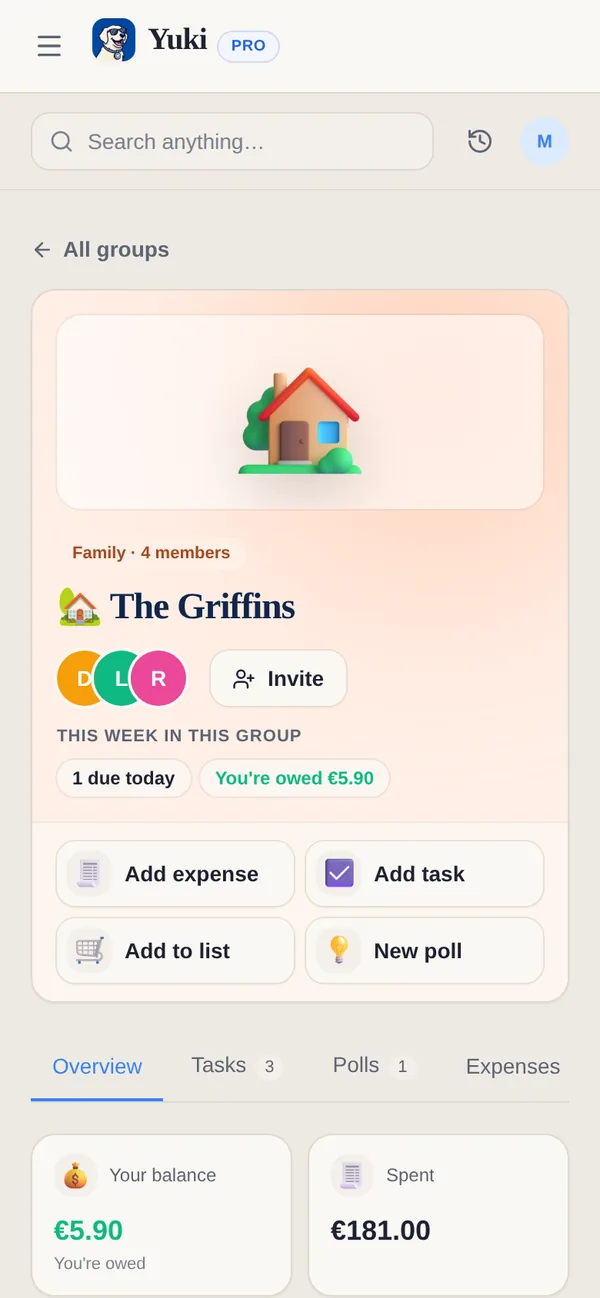
This is exactly what Yuki's shared groups are built for. You create a house group, add your roommates, log shared expenses, and Yuki keeps the per-person balances and settle-up math for you — no one person has to be the accountant. Because Yuki also reads bills and receipts from your inbox, recurring charges can be captured as they arrive instead of relying on everyone to remember.
Settle up on a rhythm, not when it boils over
Balances that sit for months turn into intimidating numbers and tense conversations. A fixed cadence fixes this: pick a settle-up day — say, the first of the month, right after rent — and everyone squares up to zero. Small, regular transfers never feel like a big deal.
Netting matters here. If Sam owes Alex for groceries and Alex owes Sam for the internet, a good ledger cancels those out so only the net difference changes hands — fewer transfers, less friction. Settle-up should tell you the minimum set of payments needed to get everyone back to zero.
Pair the money rhythm with a gentle reminder so nobody has to be the nag. Automated nudges around bill due dates and settle-up day mean the reminder comes from the app, not from the one roommate who always ends up chasing — which is far better for the friendship.
Handle the edge cases: move-ins, move-outs and uneven usage
Houses change. When someone moves out mid-month, prorate their rent and utilities to the day they leave rather than arguing over a full month. When someone moves in, reset the split percentages and note the new agreement in your shared ledger so history stays clean.
Uneven usage is the other classic flashpoint — the roommate who works from home and runs the heating all day, or the one who's away half the month. You don't need forensic accounting; agree a simple rule up front, like a small fixed weighting for the heavy user, and revisit it only if it stops feeling fair.
Deposits deserve their own line too. Record who paid what into the deposit at move-in so that when the tenancy ends, returning it is a lookup, not a memory test. Keeping this in the same shared record as your bills means the whole financial picture of the house lives in one place everyone can trust.
Step by step
- 1Agree on a rent split method (equal, by room size, or by income) and write it down before anyone moves in.
- 2List every recurring shared cost — rent, electricity, gas, water, internet, streaming — and decide who pays each provider.
- 3Pick one shared place to log expenses so every charge is visible to the whole house in real time.
- 4Log each bill as it's paid and tag who it should be split between (not everything is split evenly).
- 5Set a fixed settle-up day each month so balances never pile up into a big awkward number.
- 6Review the ledger together when someone moves in or out, or when usage changes, and adjust the split.