
Most couples don't fail at scheduling because they're disorganized — they fail because their plans are scattered. A dinner reservation sits in one person's email, a dentist appointment lives in the other's texts, and the flight confirmation is buried in an inbox nobody checked. A shared calendar only works if it's actually complete, and keeping it complete by hand is exactly the kind of invisible chore that quietly wears couples down. This guide walks through setting up a genuinely shared calendar the right way — and then removing the manual upkeep so both of you can see the whole picture without either of you becoming the household scheduler.
Start with one shared calendar, not two synced ones
The most common mistake is trying to merge two separate calendars after the fact. It's messier than it sounds: you get duplicate invites, timezone mismatches, and events that show up for one partner but not the other. Instead, create a single dedicated calendar that both people can read and write to, and treat it as the source of truth for anything that involves the two of you.
In Google Calendar, one partner creates a new calendar (e.g. 'Us') and shares it with the other using 'Make changes to events' permission. Both of you subscribe to it on every device you use. Keep your personal work calendars separate — the shared one is only for things the other person genuinely needs to see: date nights, appointments, travel, visitors, kids' schedules, bills coming due.
- One shared calendar for joint life; keep personal/work calendars separate
- Grant edit access, not just view access, so either partner can add or change plans
- Subscribe on phones and laptops so it's the same view everywhere
- Agree on a simple rule: if it affects both of you, it goes on the shared calendar
Decide what belongs on it — and who's responsible for adding it
A shared calendar is only as reliable as its worst gap. If half the appointments never make it on, both partners stop trusting it and drift back to asking 'wait, what are we doing Saturday?' The fix is a clear, low-effort agreement about what goes on and how it gets there.
The hard part is the last mile: someone still has to type in the reservation, the appointment, the flight time. That manual step is where shared calendars quietly break down — not because either person is careless, but because copying details out of a confirmation email is tedious and easy to forget. This is exactly the coordination load worth eliminating rather than assigning.
- Joint commitments: dinners, trips, parties, house guests
- Appointments the other should know about: doctor, dentist, car service
- Money moments: rent due, big renewals, shared subscriptions
- Recurring anchors: date night, family calls, birthdays and anniversaries
Feed the calendar from both inboxes automatically
Here's the shift that makes a shared calendar actually hold up: most of what you'd manually add already arrives in your email. Restaurant bookings, flight and hotel confirmations, event tickets, appointment reminders, and bill notices all land in one inbox or the other. The problem is they land in different inboxes — and neither of you sees the other's.
Yuki connects to Gmail and reads those confirmations for both partners, then turns them into real calendar events automatically. It writes two-way to Google Calendar, so an event Yuki creates shows up on your shared calendar just like one you added by hand — and edits sync back. Because it pulls from both of your inboxes into shared groups built for couples, a reservation in your partner's email becomes something you both see, without anyone forwarding or re-typing it. That's the difference between a calendar you maintain and one that maintains itself.
On iPhone, Yuki can also write to Apple Calendar (iOS only). The goal is the same either way: the plans already sitting in your inboxes end up on one calendar you both watch, with no copy-paste in between.
- Connect both partners' Gmail accounts
- Confirmations become calendar events automatically — two-way with Google Calendar
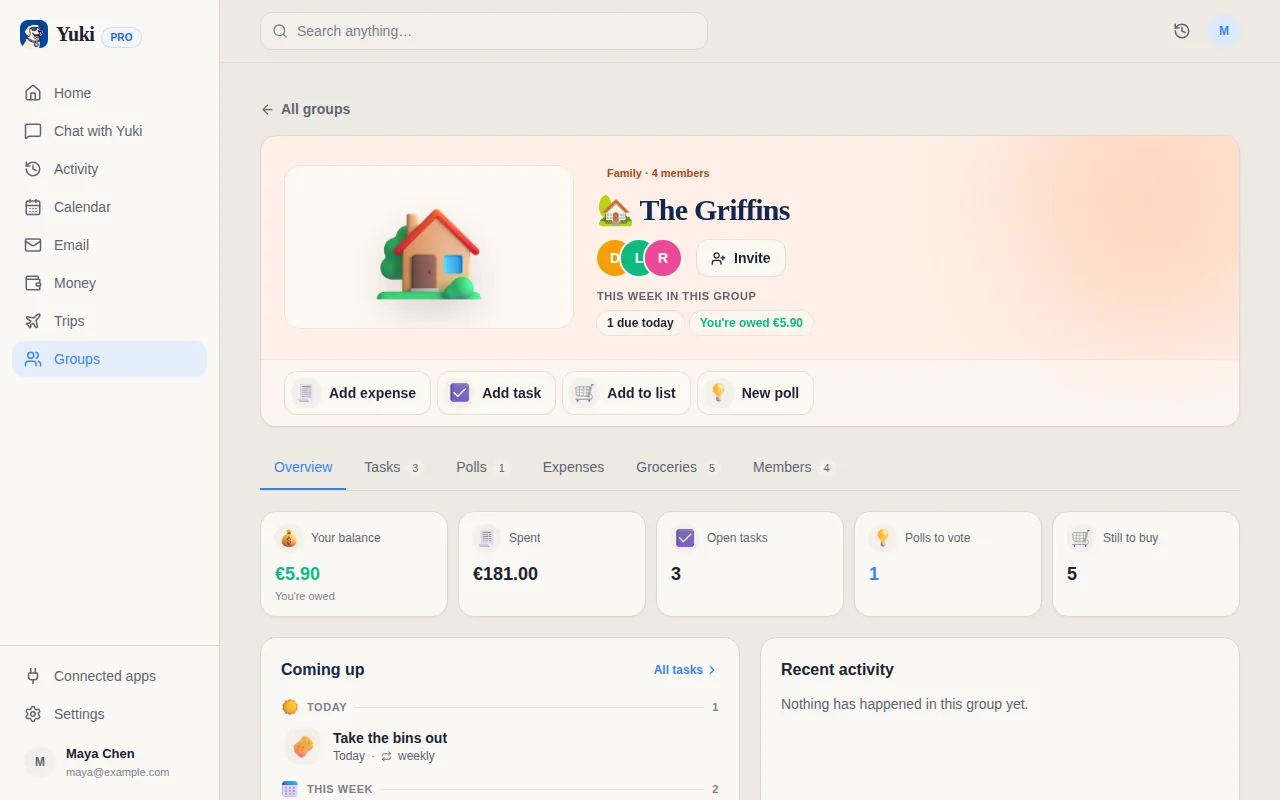
- Shared couples groups mean each person's plans surface for both
- Less 'did you put it on the calendar?' because the inbox does it for you
Cover the money and travel that scheduling usually misses
Couples calendars tend to capture social plans but miss the logistics that cause the most friction: a rent payment due, a subscription auto-renewing, a return flight neither of you noted. Because Yuki is reading the same confirmation emails, it can surface these too — tracked expenses and subscriptions, bill reminders, and full trip itineraries assembled from your flight, hotel, and rental confirmations.
For shared costs, Yuki's couples groups include bill-splitting and settle-up, so 'who paid for what' stops being a running mental tally. The point isn't more features to manage — it's that the same inbox connection that keeps your calendar full also keeps the money and travel side visible, so fewer things fall to one person to remember.
- Trip itineraries built automatically from travel confirmations
- Subscription and bill reminders so renewals aren't a surprise
- Shared expense tracking with split-and-settle for couples
- Package and delivery tracking for the stuff arriving to your door
Step by step
- 1Create one dedicated shared calendar (e.g. 'Us') in Google Calendar and keep your personal calendars separate.
- 2Share it with your partner using 'Make changes to events' access, and have both of you subscribe on every device.
- 3Agree on a simple rule for what goes on it: anything that affects both of you.
- 4Download Yuki (free, iOS and Android) and have each partner connect their Gmail.
- 5Set up a shared couples group so both inboxes feed the same calendar, expenses, and trips.
- 6Let Yuki turn confirmations, appointments, and invites into events that write two-way to your Google Calendar.
- 7Do a quick weekly glance together to confirm the shared calendar reflects the week — now a check, not a data-entry chore.